
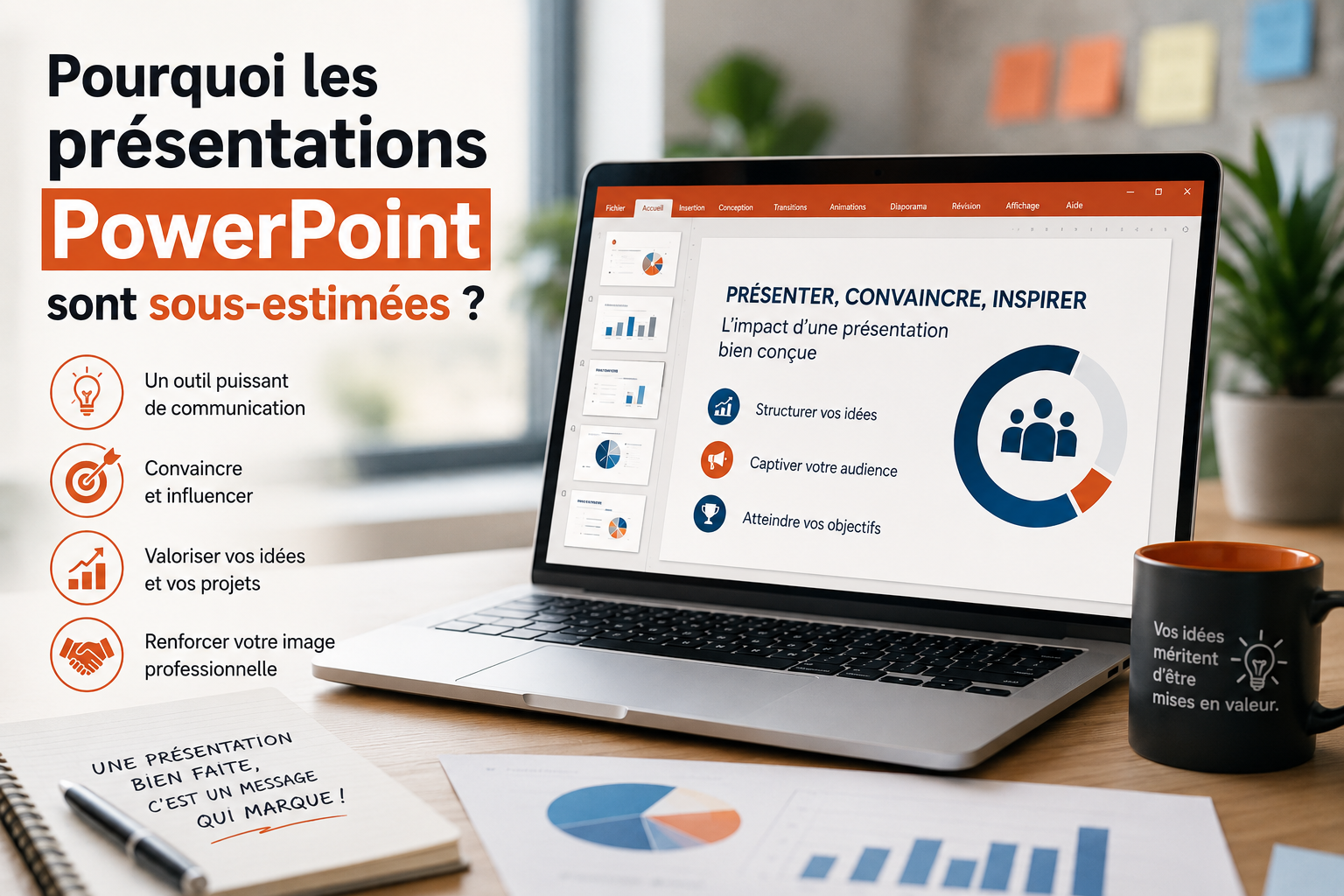
In a professional world where everything is moving fast, we tend to reduce PowerPoint to a simple suite of poorly arranged slides and chips to no longer finish. However, behind this tool, which many consider to be outdated, lies a real lever of communication, persuasion and influence. So why do PowerPoint presentations suffer from such a bad reputation when they can prove to be dreadfully effective? Decryption.
A bad reputation often unjustified
The term "death by PowerPoint" has entered the common language of companies. Overcrowded slides, illegible fonts, animations dating back to the 2000s: so many pictures that have durably tarnished the image of this tool. But confuse a misuse PowerPoint with the intrinsic limits of the tool would be a fundamental error.
The reality is that PowerPoint is a support like any other. A hammer can break a nail or break a glass — It depends on who owns it. Poorly designed presentations reflect a lack of upstream training or reflection, not technological failure. It would therefore be a reduction to condemn the tool on the basis of its worst uses.
Cognitive science researchers have also shown that humans process visual information 60,000 times faster that the plain text. A well-built slide can thus transmit in seconds what a long speech struggles to pass in several minutes.
PowerPoint, a powerful storytelling tool
What distinguishes one memorable presentation from another forgotten at the end of the meeting is the narrative that she builds. PowerPoint, in the hands of an informed communicator, becomes a true storytelling tool. Each slide can be thought of as a chapter, each visual as an emotion, each transition as a narrative rhythm.
Large companies are well understood. Apple, for example, raised the presentation to the rank of art in its legendary keynotes. It is no coincidence that these moments are expected and commented on as cultural events. The narrative structure, sleek visuals and coherent discourse turn a simple presentation into experience.
This is particularly true in the commercial field. One PowerPoint commercial presentation well thought out can make the difference between a conquered prospect and a lost contract. It guides the potential customer through an emotional and rational path, responding to his objections even before he formulates them, while valuing the offer in a structured and convincing way.
A medium that adapts to all professional contexts
One of the great strengths of PowerPoint — often neglected — is its versatility. Whether you're pitching in front of investors, training collaborators, presenting financial results or convincing a client, PowerPoint adapts to every situation.
Unlike written reports that require active and sustained reading, a well-designed presentation guides the look, prioritizes information and maintains attention. It also allows customise the speech in real time An experienced speaker may choose to fly over some slides or explore others according to the reactions of his audience. This flexibility is valuable in professional context.
In addition, PowerPoint has considerably modernized. With the integration of dynamic graphics, videos, fluid animations and even real-time data, the creative and analytical possibilities are now immense. The new features as the Designer IA or Presenter Coach make it a resolutely contemporary tool.
PowerPoint Mastery: A Full Professional Proficiency
Too few organizations train their collaborators to design effective presentations. It is often assumed that knowing how to use the software is sufficient. However, there is a considerable gap between know how to handle PowerPoint and know how to create a truly impacting presentation.
Whole disciplines — graphic design, rhetoric, cognitive psychology, visual communication — converge in creating a good slide. Learn to choose a legible typography, to use the third-party rule, to limit the number of information per slide or to build a clear thread: so many skills that turn a lambda user into a real one architect of persuasion.
Investing in this skill means investing in the brand image of your company, in the clarity of its internal messages and in the efficiency of its trade. In a market where attention is a scarce resource, the person who can capture and retain the interest of his audience has a actual competitive advantage.
Reassess PowerPoint at Fair Value
PowerPoint is not a tool of the past. It's a living medium of communication, able to tell stories, convince audiences and structure complex ideas with clarity and elegance. Its bad reputation is more the result of sloppy presentations than of any technological obsolescence.
Re-evaluate PowerPoint at its fair value, that is recognize the power of visual communication in today's professional world. It is also committed to a quality approach that is reflected in every exchange, every meeting, every pitch. The next time you open PowerPoint, do not see it as a simple slide software anymore, but as the scene on which your message will make sense.


